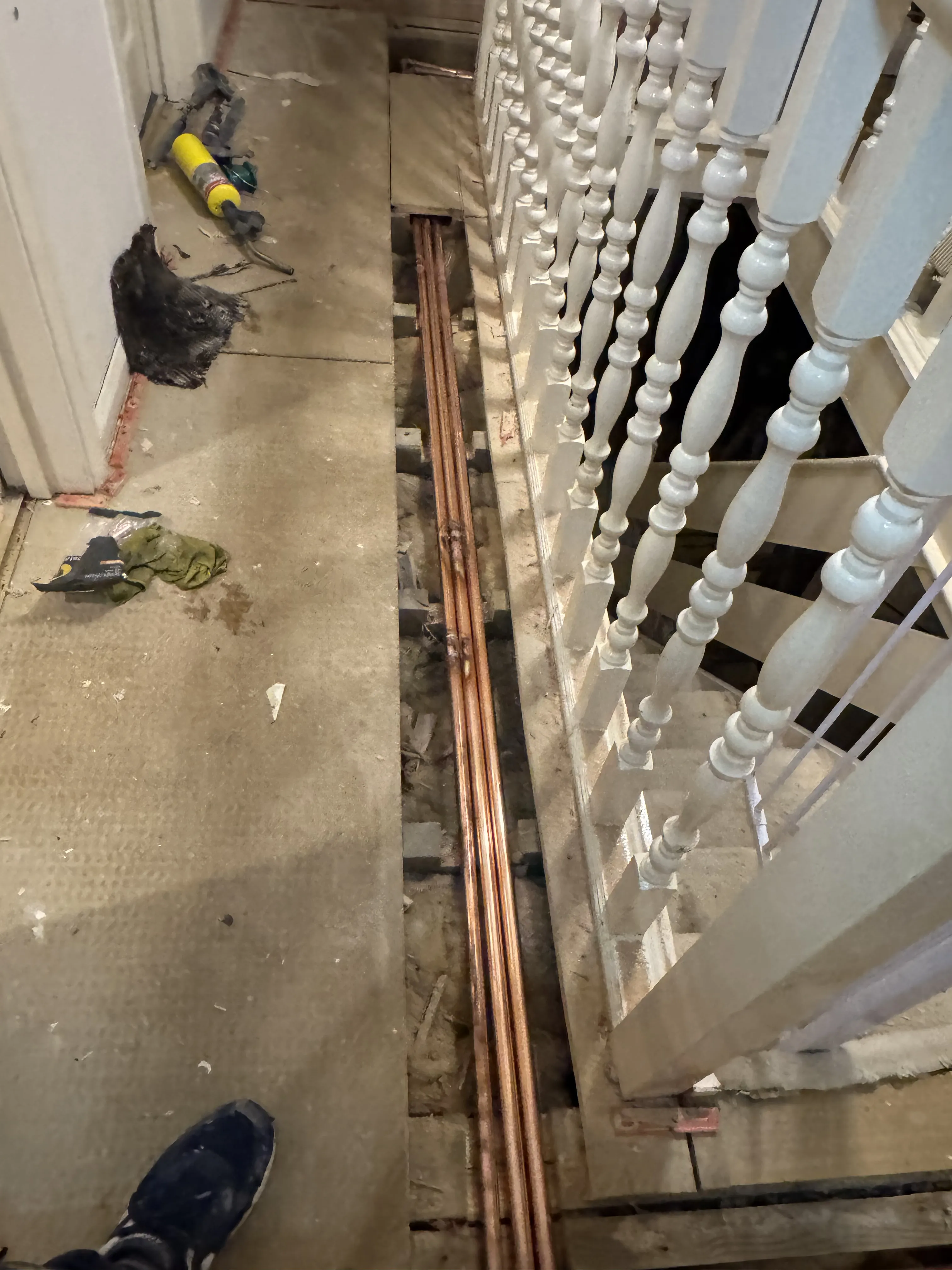
Copper water pipes running under lifted floorboards on a landing.
The signs of a hidden leak
Most leaks I am called to are not dramatic. The water is going somewhere you cannot see: into the ground along a buried supply pipe, under a floor, or behind a wall. The clues are indirect, so it pays to know them.
A water bill that is much higher than usual, when nothing in the house has changed, is often the first sign on a metered supply. Inside, look for a damp patch on a wall, ceiling or floor that keeps coming back, a musty smell, bubbling paint or lifting flooring. Outside, a patch of lawn or path that stays wet in dry weather, or a soft spot above the line of the supply pipe, can point to a leak underground.
Lower pressure than you are used to, especially at the cold tap in the kitchen, is another clue. So is a toilet cistern or loft tank that seems to be filling more often than it should.
How to check your water meter for a leak
If you have a water meter, it is the quickest way to tell whether water is escaping. Before you start, make sure nothing is using water: no taps running, no washing machine or dishwasher on, and no toilet cistern still filling. A running toilet or a dripping overflow will move the meter too, so rule those out first.
Write down the reading, or take a photo of it. Then leave everything off for at least half an hour and read it again. If the numbers have moved, water is leaving the system somewhere between the meter and your taps. Many meters also have a small dial or indicator that spins when water is flowing, which makes this quicker.
Where the meter sits matters. If it is in a chamber at the boundary, a moving meter could mean a leak anywhere along the supply pipe or inside the house. If it is inside, under the kitchen sink for example, the leak is on the house side of it.
Who is responsible for a mains water leak?
Ofwat, the water regulator for England and Wales, splits the pipework into three parts. The water company looks after the water main and the communication pipe that runs from the main to the boundary of your property, which is often where a company stop tap sits. From the boundary to the first stop tap inside your home is the supply pipe, and that is the property owner's responsibility, including the stop taps along it (Ofwat: responsibility for pipes).
That stays true even when your supply pipe runs under the road or through someone else's land. Where one supply pipe serves more than one property, the owners it serves share responsibility for it. Ofwat notes there can be special cases, so your deeds and your water company can confirm the position for your home.
Ofwat also says the owner's duty to maintain the supply pipe includes leak detection, repairs and replacement, and suggests asking your water company whether it offers help with subsidised or free repairs. If you are on a meter and a leak that has since been fixed pushed your bill up, you may be able to claim an allowance for the water lost, so it is worth contacting your water company once the repair is done.
What to do if water is escaping now
Turn off the water at your internal stopcock. It is usually under the kitchen sink, but in older houses it can be in a cupboard under the stairs, in a utility room or close to where the supply pipe comes through the floor. Turn it clockwise until it stops. If it is stiff, do not force it, because an old stopcock can snap.
Then open a cold tap to drain off what is left in the pipes, mop up what you can and move anything valuable out of the way. Take photos of any damage for your insurer.
Call or WhatsApp me on 07411 690930. My hours are Mon 7am–7:30pm, Tue–Fri 7:30am–7:30pm, Sat–Sun 7:30am–5pm, and within them a burst pipe or a leak is treated as an urgent job. If you cannot find or turn your stopcock, tell me when you call.
How I find and fix a leak
Leaks in buried or concealed pipework are a common callout, especially in older homes and country properties around Crowborough with long supply pipes. I trace the leak to its source, isolate the supply to stop the damage and make a permanent repair, whether that is a pipe under the floor, a joint behind a wall or the supply pipe outside.
Sometimes the fix is a single joint or a short length of pipe. Where an old supply pipe has failed in more than one place, replacing that run can be the better answer, and I will explain the options before any work starts. For planned work the quote is free; for urgent call-outs we agree the price on the phone before I start, so there are no surprises.
There is more about everyday repairs on my plumbing repairs and leak detection page.
Where I cover
I am based in Town Row, Rotherfield, and cover Crowborough, Rotherfield, Mayfield, Tunbridge Wells, Uckfield and the High Weald villages in between. The full list of areas shows the rest. If you think you have a leak, send me a message or call me and I will tell you how soon I can get to you.